
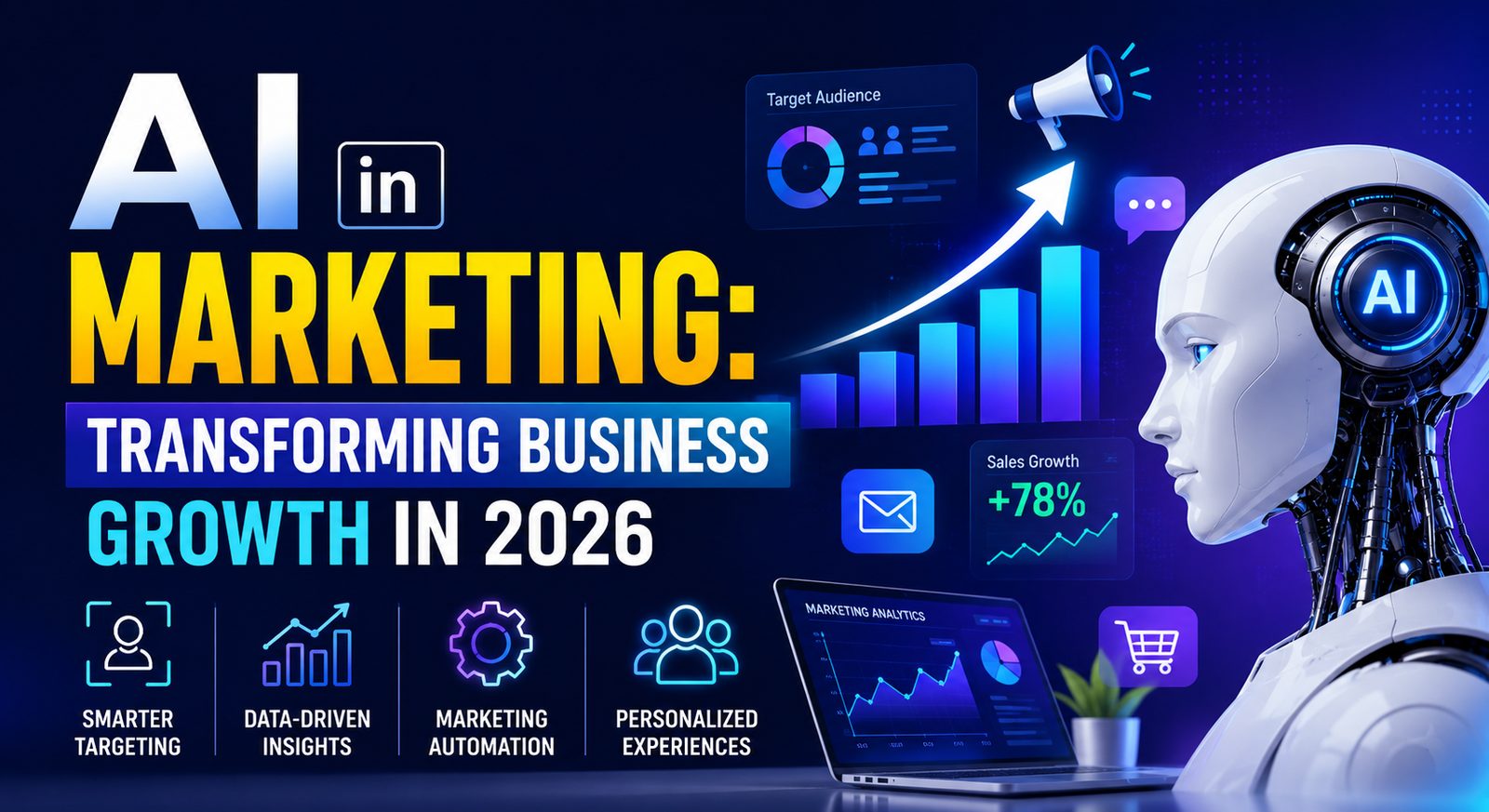
AI in Marketing: Transforming Business Growth in 2026
Introduction
Today, Artificial Intelligence (AI) has ceased to be just a promising technology but turned into a vital business tool transforming multiple industries. One of the sectors being affected the most by AI technologies is marketing. At the moment, AI-based marketing solutions of 2026 allow businesses to know more about their customers, provide tailored services, automate routine activities, and make smarter decisions based on available data.
The competition on the Internet has grown immensely. Consumers receive numerous advertisements, emails, posts on social networks, and other forms of marketing communication every single day. To make sure your message reaches the target audience, you need not only effective but intelligent tools. Intelligent systems can help businesses analyze consumer behaviors, predict upcoming tendencies, and address clients appropriately.
Therefore, artificial intelligence plays a crucial role when it comes to making a company more efficient, boosting client engagement, increasing conversion rate, and promoting business development. Regardless of whether you own a small startup, online store, or international corporation, you have a chance to get new tools for communicating with your target audience.
In this article, we are going to talk about how AI impacts marketing in 2026, what benefits it brings, the practical applications of AI, the issues businesses encounter, and future trends impacting the marketing industry.
What Is AI in Marketing?
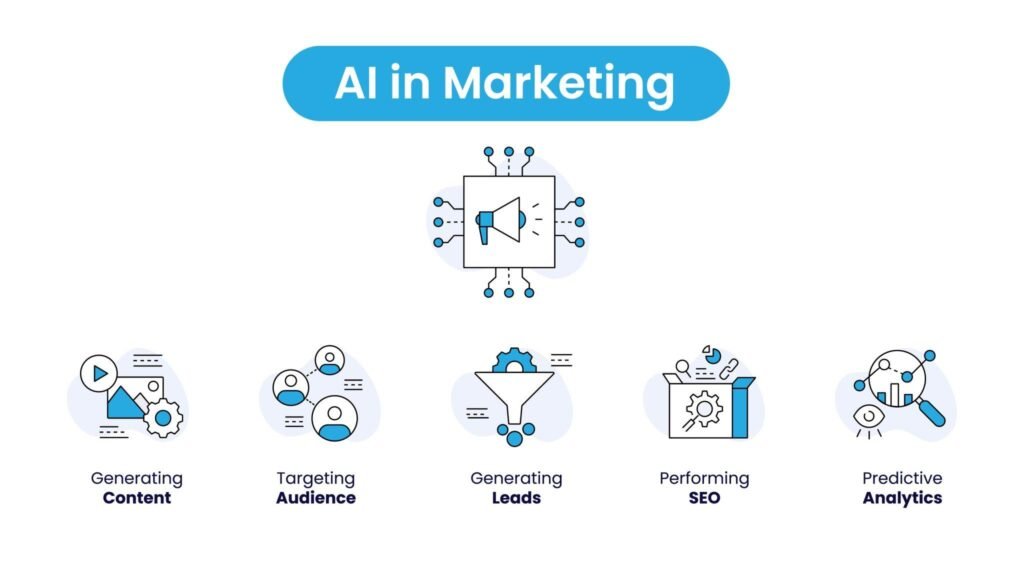
AI in marketing involves using artificial intelligence technologies, such as machine learning, NLP, predictive analytics, computer vision, and generative AI, for improving marketing operations and customer communication.
The main difference between conventional marketing tools and artificial intelligence technologies is that while the former operate based on predefined rules, the latter use data-driven insights to learn, discover patterns, and make intelligent decisions, which helps automate and optimize many marketing-related processes.
There are many application areas of AI in marketing, among which are the following:
- Segmentation
- Content generation
- SEO optimization
- Social media management
- Email marketing
- Advertising optimization
- Customer support
- Sales forecasting
- Lead generation
Thanks to its ability to quickly analyze huge amounts of data, AI technology proves to be very useful for marketers.
Why is AI important for business growth?
Businesses accumulate massive amounts of data daily from various sources like websites, mobile apps, social media platforms, purchases made by customers, and other interactions that take place online. Without AI technologies, the process of manual analysis would be rather difficult.
The importance of AI technologies for business growth can be explained based on the following points:
Speeding up the decision-making process
AI analyzes data at a faster rate compared to any human. Marketers get insights that allow them to make more rational decisions immediately.
Greater efficiency
AI automates routine processes like sending emails, audience segmentation, and analyzing results.
Better customer experience
Personalized interactions help customers understand that their needs are appreciated by the business.
More profits
Targeted and accurate communication makes it easier for companies to reach out to potential customers and make sales.
Competitive advantage
In terms of marketing, businesses using AI technology have an advantage over companies that utilize traditional marketing approaches.
Key Advantages of AI for Marketing
Personalization of Customer Experience
One of the key benefits of AI for marketing is personalization.
Customers now demand companies to know their needs and present appropriate content. By analyzing user data like browsing behavior, purchases, demographic details, and interests, businesses can provide an experience tailored specifically to the customer.
Examples may include:
- Personalized product recommendations
- Customized email marketing campaigns
- Dynamic content on the website
- Tailored ads
The provision of relevant information helps to generate higher engagement and purchase rates among consumers.
In-Depth Customer Insights
It is important for businesses to know their customers in order to effectively conduct marketing.
By analyzing customer data obtained through different communication channels, organizations gain valuable insights about their clients. For example, AI may help to determine:
- Purchase behavior
- Customer interests
- Buying patterns
- Consumer engagement trends
- Customer lifetime value
They enable marketers to come up with better strategies and build better relationships with customers.
Marketing Automation
Automation has become one of the main sources of productivity gains.
Through artificial intelligence, marketers are able to automate various processes like:
- Email marketing
- Social media posts
- Lead generation
- Customer segmentation
- Campaign optimization
In turn, marketing specialists have more time to devote to strategizing, thinking creatively, and innovating new concepts for their companies.
Greater Return on Investment (ROI)
Thanks to AI, companies are able to identify what channels, campaigns, and target audiences are most productive in terms of delivering returns on investment.
It enables marketers to budget better and minimize unnecessary advertising costs.
Customer Service
Customer service has been greatly impacted by the use of AI.
Through AI chatbots and virtual assistants, customers get immediate answers to any questions they might have, any time of the day.
Advantages include:
- Faster response times
- Lower support expenses
- Improved customer satisfaction
- Consistent customer experiences
Today, AI chatbots have become the primary mode of support for many businesses.
AI And Its Impact On Digital Marketing
AI-Driven Content Creation
Creating content is still a crucial part of digital marketing.
Here is how AI helps marketers with content creation:
- Write blog posts
- Create product descriptions
- Caption social media images
- Generate ad copy
- Write email newsletters
Human creativity still matters but using AI makes the process much faster and enables marketers to scale their operations.
Moreover, AI can suggest topics for creating new content, ensuring that the content receives more views.
Search Engine Optimization (SEO)
It has become even more important for businesses today.
AI SEO helps marketers with:
- Finding relevant keywords
- Evaluating their competitors
- Improving content optimization
- Enhancing technical SEO
- Predicting search trends
In this way, businesses can rank higher and drive more traffic to their website.
In 2026, AI-driven SEO becomes especially important due to the increasing importance of search trends.
Email Marketing
Email marketing still represents one of the most effective marketing channels available.
AI makes email marketing campaigns more successful through:
- Personalization of subject lines
- Timing optimizations
- Segmentation of audiences
- Predictions about audience engagement
- Automation of follow-ups
This leads to better open rates, click-through rates, and conversion rates.
Social Media Marketing
Social media channels collect huge volumes of data in each passing second.
AI assists companies by:
- Identifying trending topics
- Scheduling posts automatically
- Understanding audience behavior
- Monitoring brand mentions
- Generating new content ideas
These features boost social media campaigns while easing marketing department efforts.
Paid Advertising
Digital marketing is getting progressively advanced and refined.
AI optimizes paid ad campaigns through:
- High-converting audience identification
- Bid management automation
- Running tests using different ad versions
- Enhancing ad placements
- Forecasting campaign performance
These features enable businesses to leverage AI-powered tools for maximum effectiveness in their marketing efforts.
AI for Optimizing the Customer Journey
The current-day customer journey involves several steps until a purchasing decision is reached.
The customer may:
- Find out about the brand on social media
- Visit the corporate website
- Go through the blog posts
- Subscribe to newsletters
- Compare the available products
- Purchase the product(s)
AI enables businesses to follow up on all stages of this customer journey.
Using this approach, businesses will be able to:
- Enhance user engagement
- Minimize friction points
- Increase conversion rates
- Build long-term customer loyalty
Customers will always get relevant information throughout the customer journey.
Practical Use Cases of AI in Marketing
E-Commerce
Online retail stores use AI to:
- Propose new products
- Personalize customers’ experiences
- Optimize prices
- Predict future demand
All these factors lead to more sales.
Healthcare Marketing
Healthcare-related organizations use AI to:
- Customize communication with patients
- Schedule appointments
- Assess patient engagement
These actions increase overall patient satisfaction.
Financial Services
The banking and finance sector uses AI to:
- Segment customers
- Detect fraud
- Suggest personalized products
This enhances customer satisfaction and organizational performance.
Hospitality Industry
Hotels and tourism companies employ AI in:
- Recommending travel bundles
- Offering personalization
- Improving customer service
This ensures customer satisfaction and bookings.
Challenges in AI for Marketing
Despite offering various benefits, there are several obstacles that organizations need to tackle when using AI.
Privacy and Data Security
AI requires a significant amount of customer data.
It is necessary to ensure that businesses comply with privacy laws and regulations, and that customers know about how their data is being used.
High Costs of Implementation
Though technological advancements have made AI increasingly affordable, some costs might arise from software and other aspects of implementation.
Poor Data Quality
AI models depend largely on the quality of data that is supplied to them.
Low-quality data might provide incorrect outputs.
Skills Shortage
Many businesses experience challenges finding experts who possess skills in using AI.
Training personnel becomes crucial to the success of this technology.
Ethical Considerations
Companies using AI must do so in an ethical manner without compromising customer satisfaction.
Transparency and fairness are key here.
Future Trends of AI in Marketing
Hyper-Personalization
AI will enable hyper-personalized experiences based on analysis of customer behavior.
Voice Search Optimization
Voice searches will be optimized in content marketing as the use of voice assistants grows.
AI Video Creation
The creation of videos with the help of artificial intelligence would save money and time and produce highly personalized videos.
Predictive Customer Engagement
Marketing strategies would allow predicting customer behavior to engage customers proactively.
Advanced Analytics
In the future, AI would be used to gather deeper insights and better forecasting of various trends.
Conversational Marketing
With AI, marketers can make their conversations with customers more natural and personalized through virtual assistants.
Best Practices for Leveraging AI Marketing
To ensure success in AI marketing efforts, businesses should:
- Establish concrete objectives.
- Work with quality data.
- Undertake AI projects of smaller scale.
- Regularly analyze their performance.
- Combine human creativity with AI technology.
- Protect customers’ personal data.
- Train employees in marketing.
All these measures would contribute to the best possible results from using artificial intelligence.
Join our youtube channel to get more info
Conclusion
The use of AI in marketing has changed the face of business development in 2026 through its ability to facilitate customization, automation, decision-making, and increased customer engagement. Firms that adopt AI are experiencing considerable competitive advantage in this day and age of technological innovations.
Through the application of AI technology in activities ranging from content generation, SEO, customer services to predictive analysis, marketers are becoming more effective and efficient in achieving their goals. With time, the integration of AI in marketing approaches is bound to become even more pronounced than it is currently.
Firms that adopt AI in their marketing strategies stand to gain in the future due to increased efficiency and effectiveness. This technology cannot go ignored anymore; instead, it must be embraced if businesses are to succeed in this digital age.