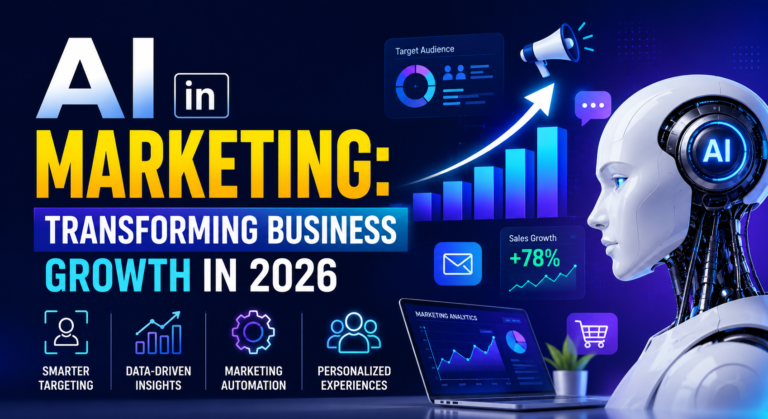


How Artificial Intelligence Is Transforming Modern Business in 2026
Introduction
Artificial Intelligence (AI) technology is no longer just a thing of the future because it is already here now and influencing various aspects of our lives. In 2026, the use of artificial intelligence in business becomes even more widespread because companies start using AI not only as an additional element but also as one of the driving factors. It allows organizations of all sizes, both small and large, to benefit significantly from the application of artificial intelligence.
Advances in AI, including machine learning, natural language processing, and generative AI, have enabled businesses to process large amounts of data, automate different operations and make informed decisions promptly. Thus, businesses that use AI successfully are getting considerable advantages over other companies.
In the following sections, the paper will address the impact of AI on modern business and describe the advantages, challenges and future of AI in this area.

Rise of AI in Businesses
The adoption of AI in businesses has risen significantly. Most businesses have adopted AI in some sections of their operations. They are no longer piloting but implementing AI solutions in various departments in large amounts. Research reveals that there is rapid growth in the adoption of AI in enterprises. Companies are adopting AI in their strategies and planning.
One of the most crucial developments in 2026 is the integration of AI into business operations. Rather than having separate AI applications, firms will incorporate AI into systems and infrastructure. The global AI market has grown immensely, and projections indicate that it might reach over $4 trillion by 2030 owing to robust enterprise adoption.
1. AI-Powered Automation and Efficiency
Automation is one of the critical ways in which AI is shaping modern businesses. AI-driven technologies can automate repetitive and mundane operations. This frees up time for employees to undertake essential roles.
Benefits:
- Cost savings
- Improved productivity
- Efficient operations
- Increased speed
Automation by AI tools:
- Data input
- Customer service via chatbots
- Inventory management
- Accounting reports
However, as of 2026, AI agents will get more advanced. These tools are capable of completing several activities independently from other people, which allows for increased efficiency and changes to workflow.
As a consequence, there are tangible improvements in business performance. For example, some businesses manage to achieve a considerable return on investment in terms of AI usage, as the figures demonstrate $3 in gains for every dollar invested in AI technologies.

2. Improved Decision-Making through Data Analytics
Data is a critical resource in modern business environments, and AI changes how companies use it. Namely, data analytics software powered by AI can analyze large volumes of information instantly, discover patterns, and provide insights that cannot be detected manually.
The role of AI in decision-making:
- Predictive analytics for trends prediction
- Business intelligence in real time
- Fraud detection and risk assessment
- Personalization of recommendations
With the help of AI, companies stopped making decisions based on gut feelings and started using data for evidence-based actions. Consequently, the results improved, and there was less risk associated with each decision.
3. Personalized Customer Experience
The demands of customers have shifted dramatically in the digital era. Now, customers expect personalized, quick, and seamless experiences, which AI helps provide.
Applications of AI in Customer Experience:
- Chatbots and virtual assistants
- Personalized product suggestions
- Dynamic pricing tactics
- Analysis of customer behavior
With the help of AI, businesses can learn about their customers’ preferences and give personalized services instantly. For instance, through the analysis of customer behavior and preferences, AI can make suggestions for products or services.
Marketing is an area where businesses are trying to shift from guessing to precision. They are doing this by identifying the correct customers with the correct messaging.
4. AI in Marketing and Sales
AI has revolutionized the field of marketing and sales. Today, marketers are using artificial intelligence tools to streamline campaigns, create content, and predict customer behavior.
Critical AI Marketing Functions:
- Content generation
- Lead scoring and classification
- Optimization of email marketing campaigns
- Analytics for social media platforms
AI marketing platforms are capable of analyzing consumer information and automatically optimizing campaigns to ensure maximum effectiveness. As a result, the investment made in marketing initiatives yields higher returns.
In addition, AI helps in sales processes through gaining insights on customer intent, increasing conversion rates, and streamlining follow-up actions.
5. Innovation and Novelty Business Models
In addition to transforming traditional business operations, AI allows creating entirely new models.
AI-driven Innovations:
- SaaS AI applications
- Autonomous services and products
- Subscription-based AI solutions
- Models based on providing access to data
Many firms are applying artificial intelligence in their product development and service provision processes. Approximately one-third of businesses report using AI technology to innovate and create new business models.
6. AI in Human Resource Management and Workforce Transformations
Moreover, AI is also used in the area of HR management to increase efficiency at work. From candidate recruitment to performance management and employee engagement, the AI application becomes an irreplaceable part of HR processes.
Main Applications of AI for Human Resources Include:
- CV analysis
- Employee performance evaluation
- Workforce management
- Professional training
But the rise of AI has led to new difficulties that businesses should deal with when implementing new technologies. Thus, one of the most significant challenges for organizations is the AI skills gap. To solve this problem, firms invest in training sessions that would help improve AI literacy among the workforce.
7. AI in Operations and Supply Chain Management
Furthermore, AI helps make operations and supply chain management more efficient and effective. It allows businesses to reduce risks, improve performance and efficiency, and increase transparency.
Key Applications of AI in Operations and Supply Chain Management Include:
- Demand forecasting
- Inventory optimization
- Logistics
- Supply chain risk management
Using machine learning algorithms and predictive analytics, AI helps prevent disruptions by identifying the potential risk factors in advance.
8. AI and Cybersecurity
With the digitalization of modern businesses, cybersecurity has become one of the main concerns for enterprises. AI technologies play an important role in preventing cyberattacks.
Functions of AI in Cybersecurity:
- Threat detection and prevention
- Fraud detection
- Continuous monitoring
- Risk management
Thanks to AI technologies, businesses can detect risks and respond to potential threats faster, thus ensuring greater cybersecurity.
9. Barriers to AI Implementation
However, despite the number of benefits that can be gained through the implementation of AI, there are still some barriers to the application of artificial intelligence solutions.
Main Obstacles:
- High implementation expenses
- Talent shortage
- Inefficient data
- Complex integration with existing processes
Some organizations make considerable investments in AI but cannot see any positive results because of improper approaches to implementation or poor infrastructure.
Therefore, a well-elaborated AI strategy aimed at specific use cases is of great importance.
9. Challenges to AI Implementation
Even with all the advantages, the implementation of artificial intelligence also presents some challenges. Many businesses face difficulties when they try to implement artificial intelligence technologies.
Some of the common challenges include:
- Expensive implementation costs
- Unavailability of talent
- Inadequate data
- Issues with integrating new technology with old ones
Some firms spend heavily on AI technology but do not yield any significant results because of poor implementation processes or poor infrastructure.
It emphasizes the need for an AI strategy as well as focusing on some specific use cases rather than implementing AI in every part of business.
10. The Future of AI in Business
The future looks bright for the use of artificial intelligence in business organizations. The following are some of the emerging trends in AI usage:
- Implementation of artificial intelligence agents
- Automation of highly complicated business activities
- Enhancement in personalization of customers’ experiences
- Decision making aided by artificial intelligence
- Growing ethical concerns regarding AI
More information join our youtube channel
Conclusion
The introduction of Artificial Intelligence is radically changing modern business in 2026. This technology impacts all facets of the way businesses operate.
Those who make use of AI in an efficient manner are becoming more productive, making informed decisions, and gaining a competitive edge. Yet, success in this area cannot be achieved using technology alone; strategy, expertise, and the ability to change are essential elements of success.
One thing that is obvious as time goes on is that AI cannot be ignored anymore by modern enterprises. It has become necessary for them to succeed.
Modern enterprises that adopt AI today will shape the future of their operations.